
Wisdom Teeth Removal with Medical Conditions: What You Need to Know Before Surgery
Have a health condition or take daily medications? Learn how pregnancy, blood thinners, diabetes, heart conditions, and other factors affect your wisdom teeth removal — and what to disclose before surgery.
wisdom teeth removal medical conditions
Most wisdom teeth removal patients are healthy young adults with no medical complexity. But a significant number of patients — including adults in their 30s, 40s, and beyond — arrive at the consultation with health conditions, prescription medications, or other medical factors that require specific consideration before surgery.
This article covers the most commonly encountered medical conditions and medications that affect wisdom teeth removal planning — what they mean for surgical safety, what modifications are required, and what patients should disclose to their clinical team before any procedure is scheduled.
A critical note before reading: this article is for general educational purposes. It does not constitute medical advice and does not replace the individualized clinical assessment your surgical team will conduct before your procedure. Always disclose your complete medical history and medication list to your surgeon.
Key Takeaways
Most patients with medical conditions can safely undergo wisdom teeth removal with appropriate planning and, in some cases, medical clearance from their physician.
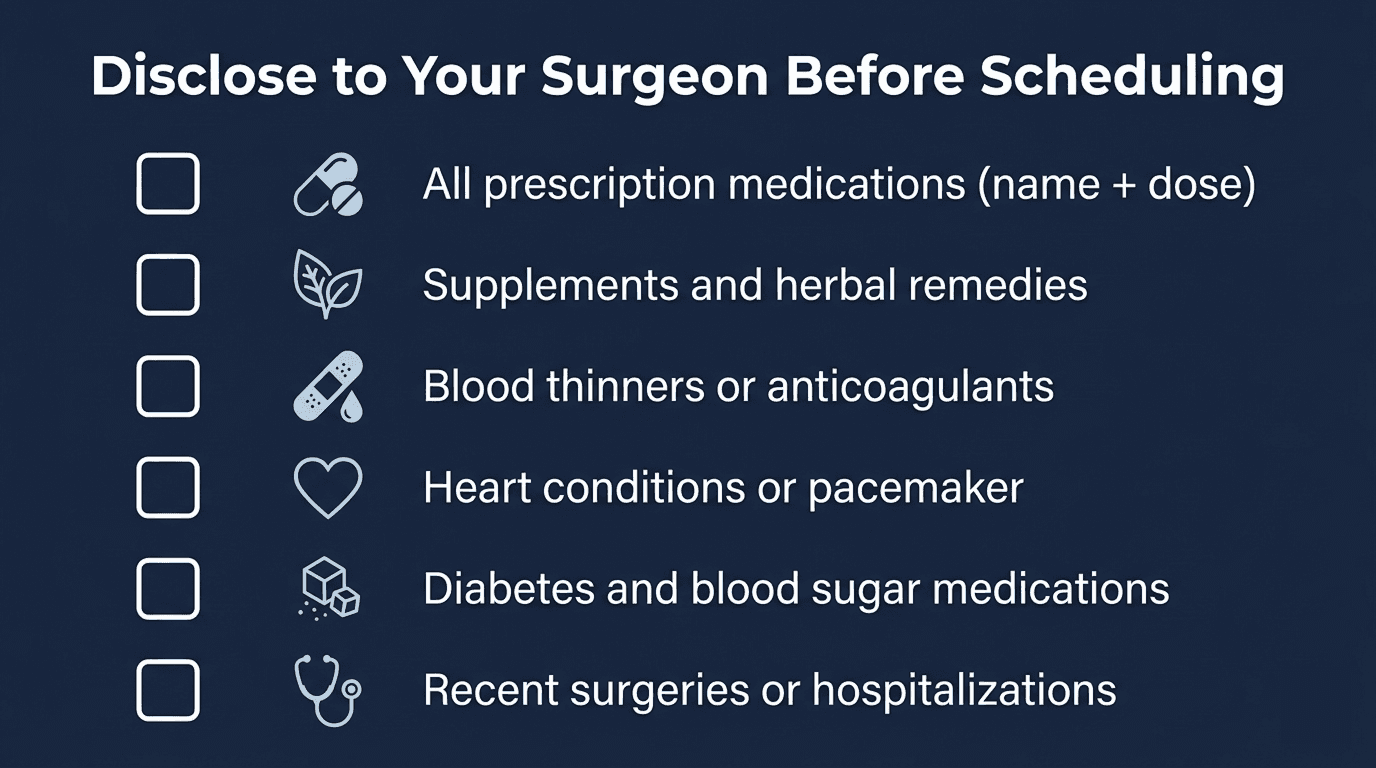
Complete and accurate disclosure of your health history and all medications — including supplements, herbal remedies, and over-the-counter drugs — is essential before surgery.
Several common medications (blood thinners, SSRIs, NSAIDs) require specific pre-operative management protocols.
Pregnancy is a special circumstance: elective wisdom teeth removal is generally deferred until after delivery, but emergency treatment can be provided safely.
IV sedation requires a thorough pre-operative health review — the screening is specifically designed to identify and manage individual risk factors.
Pregnancy
The General Recommendation: Defer if Possible
Elective wisdom teeth removal is generally deferred until after pregnancy. This is the standard recommendation from both dental and obstetric professional organizations. The reasoning is not that the procedure is highly dangerous during pregnancy — it is that elective surgery carries risk that is best avoided when it can be.
Concerns specific to pregnancy include:
Fetal exposure to medications used for sedation and pain management
Radiation exposure from dental X-rays (though modern digital X-rays involve minimal radiation and can be performed with a lead apron when clinically necessary)
The physiological stress of surgery and recovery during a pregnancy
If Treatment Cannot Be Deferred: The Second Trimester Window
When wisdom teeth removal is genuinely necessary during pregnancy — due to active infection, severe pain, or a condition that poses risk to the pregnancy itself if untreated — the second trimester (weeks 14–28) is the preferred window. Organogenesis (critical fetal organ development) is complete after the first trimester, and the third trimester introduces logistical challenges (positioning, increased physiological burden).
Local anesthesia (lidocaine) is considered safe during pregnancy. Sedation choices require careful consultation with both the oral surgeon and the patient's OB-GYN. Nitrous oxide is typically avoided in the first trimester; its use in other trimesters varies by clinical judgment.
Breastfeeding
Breastfeeding patients can safely undergo wisdom teeth removal. Most medications used in oral surgery — local anesthetics, antibiotics like amoxicillin, and common pain medications — pass into breast milk in small amounts considered clinically insignificant. Patients should pump and discard milk during and immediately after IV sedation and for the duration of any prescribed medications they wish to avoid passing through breast milk. Discuss this specifically with your surgeon at the pre-op consultation.
Blood Thinners and Anticoagulant Medications
This is one of the most common medical medication considerations in oral surgery. Patients on anticoagulants — including warfarin (Coumadin), newer direct oral anticoagulants (DOACs) like rivaroxaban (Xarelto), apixaban (Eliquis), and dabigatran (Pradaxa), and antiplatelet agents like aspirin or clopidogrel (Plavix) — require pre-operative management.
The Core Clinical Challenge
Anticoagulants reduce the blood's clotting capacity — which is their intended therapeutic function. In a surgical context, this can increase post-operative bleeding. The clinical challenge is that stopping anticoagulants to reduce bleeding risk must be weighed against the risk of the underlying condition the medication is treating (atrial fibrillation, DVT, prosthetic heart valve, etc.).
What Management Typically Looks Like
Aspirin (low-dose, 81mg): Most oral surgeons proceed without discontinuation for routine extractions. The bleeding increase is manageable with local hemostatic measures.
NSAIDs (ibuprofen, naproxen): Should be discontinued 3–7 days before surgery per surgeon recommendation. These have antiplatelet effects beyond their anti-inflammatory properties.
Warfarin: Requires INR (International Normalized Ratio) testing within 24–72 hours of surgery. Most oral surgery is safe when INR is within the therapeutic range (2.0–3.5). Dose adjustment requires coordination with the prescribing physician.
DOACs (Xarelto, Eliquis, Pradaxa): Often held for one to two doses before surgery, depending on specific agent, dose, and kidney function. Requires coordination with prescribing physician.
Clopidogrel (Plavix): Typically requires physician consultation before discontinuation — stopping abruptly increases cardiovascular risk for patients on dual antiplatelet therapy after stent placement.
Never discontinue prescription anticoagulants without coordination between your oral surgeon and your prescribing physician. This is a clinical decision that weighs surgical bleeding risk against the risk of the underlying condition — not a unilateral call by either provider.
Diabetes
Diabetes is one of the most common systemic conditions encountered in surgical patients, and it is very manageable in the wisdom teeth removal context with appropriate planning.
Why Diabetes Requires Consideration
Wound healing: Elevated blood glucose impairs neutrophil function and collagen synthesis — the foundations of wound healing. Poorly controlled diabetes is associated with higher infection risk and slower healing after oral surgery.
Infection risk: Diabetic patients have higher baseline susceptibility to oral bacterial infections. Post-operative antibiotic prescribing decisions are made with this in mind.
Blood glucose management: Fasting requirements for IV sedation require specific planning for diabetic patients on insulin or other glucose-lowering medications. Surgery itself is a physiological stress that elevates blood glucose.
What Well-Controlled Diabetes Means Clinically
Patients with well-controlled diabetes (HbA1c under 7–8%) can safely undergo wisdom teeth removal without significant additional risk compared to non-diabetic patients. Morning appointments are generally preferred — consistent with medication and meal timing for most diabetes management regimens.
Patients should communicate their diabetes management plan, current HbA1c, and specific medications to the surgical team. Coordination with the primary care physician or endocrinologist may be appropriate for patients with less well-controlled diabetes.
Heart Conditions
Antibiotic Prophylaxis: Who Actually Needs It
Current American Heart Association (AHA) guidelines restrict antibiotic prophylaxis before dental procedures to a specific subset of high-risk cardiac patients — not all patients with heart conditions. Prophylaxis is recommended for:
Patients with prosthetic heart valves or prosthetic material used for valve repair
Patients with a history of infective endocarditis
Patients with congenital heart disease in specific categories (unrepaired cyanotic CHD, repaired CHD with residual defects adjacent to prosthetic material, or within 6 months of a completely repaired defect)
Cardiac transplant recipients with valvular regurgitation
Patients with common cardiac conditions — coronary artery disease, hypertension, atrial fibrillation, prior heart attack, pacemakers — do not require antibiotic prophylaxis before dental procedures under current guidelines, though they do require careful medical history review before sedation.
Blood Pressure
Significantly elevated blood pressure at the time of surgery increases bleeding risk and is a relative contraindication to elective procedures. Most oral surgery practices take a pre-operative blood pressure. Readings above approximately 180/110 mmHg may prompt rescheduling until blood pressure is better controlled.
Common Medications That Require Disclosure
SSRIs and SNRIs (Antidepressants)
Selective serotonin reuptake inhibitors (SSRIs) — including fluoxetine, sertraline, escitalopram — and SNRIs affect platelet aggregation and are associated with mildly increased bleeding tendency. The clinical significance is generally modest for routine extractions, but disclosure is important because these medications also interact with specific sedation agents.
Additionally, SSRIs in combination with tramadol (an opioid occasionally used for post-surgical pain) can increase the risk of serotonin syndrome — a potentially serious interaction. Always disclose SSRI/SNRI use before any prescription pain medication is selected.
Bisphosphonates
Bisphosphonates — including alendronate (Fosamax), risedronate (Actonel), and IV forms used in cancer treatment like zoledronic acid (Zometa) — are used for osteoporosis and certain cancers. In the oral surgery context, these medications are associated with a rare but serious condition called medication-related osteonecrosis of the jaw (MRONJ) — impaired bone healing following oral surgery that can lead to exposed, non-healing bone.
The risk is substantially higher with IV bisphosphonates than with low-dose oral forms (the type used for osteoporosis). Patients on any bisphosphonate should disclose this and the duration of use before wisdom teeth removal. Your surgical team will assess the specific risk and discuss options including a 'drug holiday' before elective surgery for some patients.
Corticosteroids
Long-term systemic corticosteroid use (prednisone, dexamethasone) can affect immune response, wound healing, and adrenal function. Patients on chronic steroid therapy may require a stress dose adjustment around the time of surgery — a decision made in coordination with the prescribing physician.
Herbal Supplements
Several commonly used herbal supplements have clinically meaningful effects on bleeding, sedation, or drug metabolism:
Garlic, ginkgo biloba, vitamin E, fish oil: Antiplatelet effects — increase bleeding tendency.
St. John's Wort: CYP450 enzyme inducer — can alter the metabolism of sedation medications and antibiotics.
Kava: CNS depressant — can potentiate sedation agents.
Many patients do not mention supplements because they don't think of them as 'medications.' They are. Disclose all supplements at least two weeks before surgery.
Have a medical condition or take daily medications? Bring your complete medication list to your consultation. Call (801) 370-0050 or book at drwisdomteeth.com.
The Pre-Operative Screening Process
At Dr. Wisdom Teeth, every patient completes a detailed health history before their procedure. The pre-operative screening is specifically designed to identify and address the factors discussed in this article before surgery day — not on the morning of the appointment.
What the screening covers:
Current medical diagnoses and relevant history
Complete medication list including OTC drugs and supplements
Prior anesthesia experience and any adverse reactions
Allergies (medications, latex, antiseptics)
Relevant family history (anesthesia reactions)
Social history including smoking and alcohol use
The clinical team reviews this information and communicates directly with the patient's physician when medical clearance or medication coordination is needed before proceeding.
Frequently Asked Questions
I take ibuprofen every day for chronic pain. Do I need to stop before surgery?
Yes. Ibuprofen and other NSAIDs should typically be discontinued 3–7 days before wisdom teeth removal. They inhibit platelet function, increasing bleeding risk. Discuss pain management alternatives for the pre-operative period with your surgeon and primary care provider.
I have a pacemaker. Is IV sedation safe for me?
Generally yes, with appropriate disclosure. Modern pacemakers are designed to function through the minor electromagnetic interference generated by standard dental equipment. The surgical team should be informed of pacemaker presence and the specific model and manufacturer when possible. IV sedation is typically safe for pacemaker patients when the clinical team is appropriately informed.
I'm on Eliquis for atrial fibrillation. My cardiologist said not to stop it. What happens?
This is precisely the clinical coordination that should occur. Your oral surgeon and cardiologist should communicate about the specific approach — which may involve proceeding with enhanced local hemostatic measures while continuing the medication, or a carefully timed brief hold coordinated between both providers. Do not stop it unilaterally.
I have severe anxiety and take benzodiazepines. Does that affect sedation?
Yes — chronic benzodiazepine use can affect sedation medication requirements (tolerance can mean standard doses produce less effect). Disclose all psychiatric medications including benzodiazepines, SSRIs, antipsychotics, and mood stabilizers at your pre-operative consultation.
The Bottom Line
Having a medical condition or taking daily medications does not disqualify you from wisdom teeth removal. In most cases, appropriate planning, medical coordination, and transparent disclosure are all that is required to proceed safely. The pre-operative screening process at Dr. Wisdom Teeth exists precisely to identify and address individual medical factors before the day of surgery — so there are no surprises.
The single most important thing you can do is be completely transparent about your medical history and current medications at your consultation. Nothing you disclose will be used to refuse care without clinical reason — it will be used to make your care as safe as possible.
Schedule your consultation: drwisdomteeth.com | (801) 370-0050 | Mon–Fri 8am–5pmProvo: 2230 N University Pkwy #8A | Murray: 5888 S 900 E #101
Written by
Dr. Wisdom Teeth
Resources