
Wisdom Teeth and Braces: Will They Undo Your Orthodontic Results?
Worried your wisdom teeth will shift teeth you spent years straightening? Here's what the research actually says, when removal is recommended, and how to protect your results.
Orthodontics
It's one of the most common concerns among patients finishing orthodontic treatment: after two or three years of braces or aligners, will emerging wisdom teeth push everything back out of alignment?
The honest answer is more nuanced than either extreme you'll find online. Some sources treat wisdom teeth as the guaranteed destroyer of orthodontic work; others dismiss the connection entirely. Neither reflects what the clinical evidence actually shows. This article covers what is genuinely established, what remains debated, and what practical steps protect your results regardless of which side of the debate you find more convincing.
Key Takeaways
The relationship between wisdom teeth and post-orthodontic crowding is genuinely debated in research — it is not a settled fact in either direction.
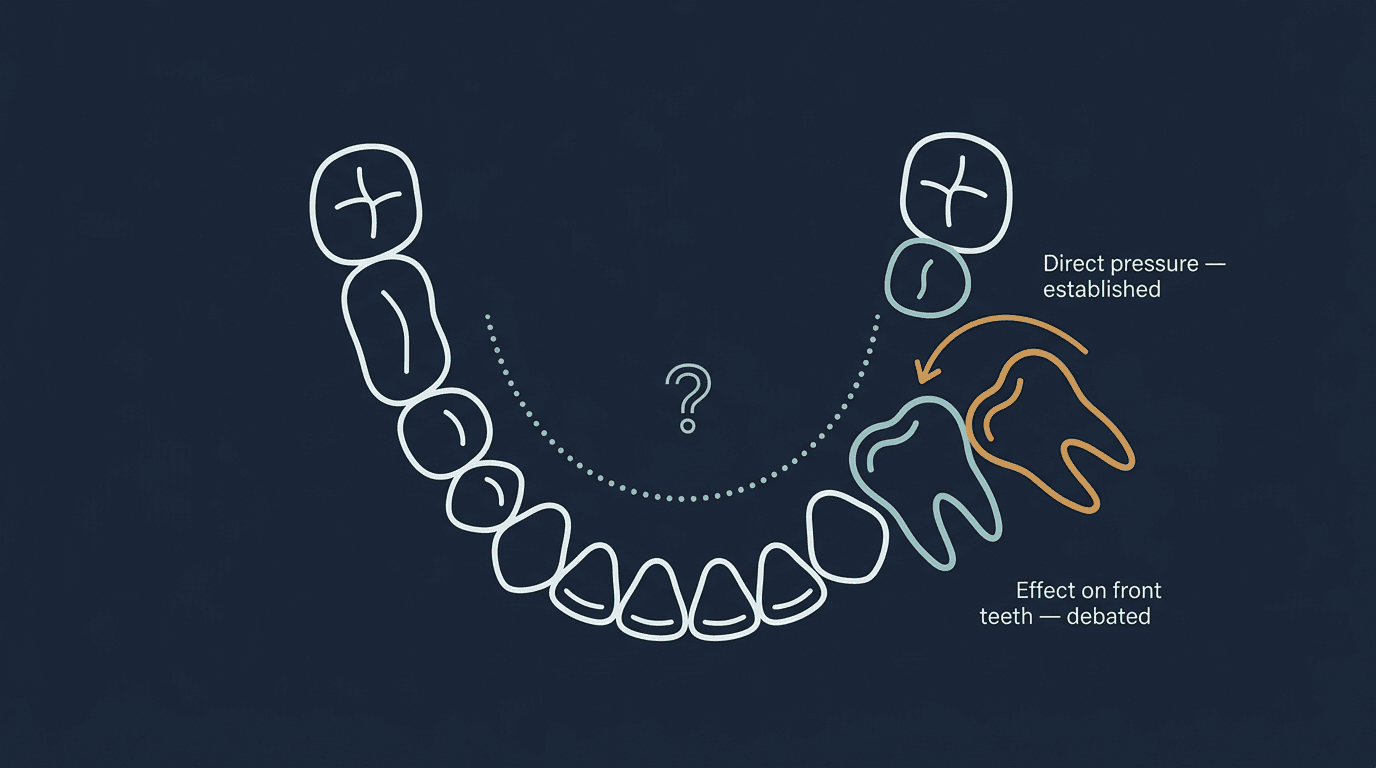
What is well established: an impacted, forward-angled wisdom tooth does exert pressure on the adjacent second molar.
Late lower front tooth crowding occurs in many adults regardless of whether they have wisdom teeth — including in people born without them.
Consistent retainer wear is the single most effective protection for orthodontic results, more so than wisdom tooth status.
Wisdom teeth are often recommended for removal after orthodontic treatment for reasons unrelated to crowding — impaction, hygiene access, and cyst risk.
What the Research Actually Shows
The Traditional Assumption
For decades, the prevailing clinical assumption was straightforward: erupting wisdom teeth push forward against the molars ahead of them, and that force transmits through the dental arch, causing the lower front teeth to crowd. Many orthodontists routinely recommended wisdom tooth removal near the end of treatment specifically to protect the result.
What Later Research Complicated
More recent studies have challenged the strength of this causal link. The key finding that complicated the traditional view: late lower incisor crowding occurs at similar rates in patients who never had wisdom teeth — including those congenitally missing them and those who had them removed years earlier — as in patients whose wisdom teeth remained.
This suggests that other factors contribute significantly to late crowding, including:
Natural age-related changes in jaw structure and tooth position that continue throughout adulthood
Forward drift of teeth as a general lifetime phenomenon, independent of third molars
Soft tissue pressure from lips, cheeks, and tongue over time
Inconsistent retainer wear after active orthodontic treatment ends
Individual differences in periodontal ligament behavior and bone remodeling
Where the Evidence Does Point Clearly
What is not debated: an impacted wisdom tooth angled toward the second molar exerts direct, sustained pressure on that adjacent tooth. This is visible on X-rays and is a recognized cause of root resorption of the second molar in some cases. The debate is not about whether that local pressure exists — it's about how much of it translates into visible front-tooth crowding several teeth away.
The practical implication: the clearest reasons to remove wisdom teeth in orthodontic patients are usually local — impaction, pressure on the adjacent molar, difficulty cleaning, and cyst risk — rather than the more debated question of front-tooth alignment.
Common Scenarios and What They Mean
Scenario 1: Braces Just Removed, Wisdom Teeth Not Yet Erupted
This is the most common presentation among teenagers. The orthodontist has completed treatment, and a panoramic X-ray shows developing wisdom teeth still below the gumline.
The typical recommendation here is evaluation rather than automatic removal. What matters is the position and trajectory of each wisdom tooth on the X-ray. If they are clearly angled into impaction — which is the case for a substantial majority of patients — removal during the late teens is generally favorable, both because roots are less developed and because impacted teeth carry their own risks independent of the crowding question.
Scenario 2: Front Teeth Already Shifting After Orthodontic Treatment
If crowding has already begun to develop, removing wisdom teeth will not reverse it. Extraction stops any forward pressure that may be contributing, but it does not move teeth back into alignment.
Addressing existing shifting requires orthodontic intervention — often a short course of clear aligners or a fixed retainer adjustment. This is a conversation for your orthodontist. Wisdom tooth removal, if indicated, is a separate and parallel decision made based on the wisdom teeth themselves.
Scenario 3: Adult Patient, Braces Years Ago, Wisdom Teeth Still Present
Many adults in their late twenties and thirties still have their wisdom teeth and notice gradual front tooth crowding. The temptation is to attribute the crowding to the wisdom teeth and consider removal as a corrective measure.
This framing is usually incorrect. Late crowding at this stage is more likely multifactorial, and removal will not reverse it. However, an evaluation is still worthwhile — for the independent reasons that apply to any adult with retained wisdom teeth: impaction status, adjacent tooth health, periodontal pocket depth around the third molar sites, and any signs of cyst development.
Timing: Should Wisdom Teeth Come Out Before, During, or After Braces?
Before Orthodontic Treatment
Generally uncommon unless wisdom teeth are already causing an active problem — infection, significant pain, or a position that directly interferes with planned tooth movement. In most cases orthodontic treatment proceeds without needing wisdom teeth addressed first.
During Orthodontic Treatment
Occasionally recommended when a wisdom tooth is physically obstructing planned molar movement, or when a developing problem — such as pericoronitis or a cyst — needs attention regardless of the orthodontic timeline. Coordination between the orthodontist and oral surgeon is important here so treatment isn't unnecessarily interrupted.
After Orthodontic Treatment — The Most Common Timing
This is the most typical scenario. Braces or aligners come off, retainers begin, and wisdom teeth are evaluated separately. For teenagers finishing orthodontics around ages 15–17, this often aligns well with the favorable window for wisdom tooth removal in the late teens — when roots are less developed and healing tends to be quicker.
Just finished braces and wondering about your wisdom teeth? A consultation and current X-ray gives you a clear answer. Call (801) 370-0050 or book at drwisdomteeth.com.
What Actually Protects Your Orthodontic Results
Regardless of where you land on the wisdom teeth debate, these factors have clearer and better-established effects on maintaining alignment:
Consistent retainer wear. This is the single most impactful variable. Orthodontic relapse is strongly associated with inconsistent or discontinued retainer use. Follow your orthodontist's specific protocol — typically full-time initially, then nightly indefinitely.
Replacing worn or lost retainers promptly. A retainer that no longer fits properly provides incomplete retention. Gaps of weeks or months without a functional retainer are when relapse most often begins.
Regular dental checkups. Routine visits catch early shifting when it's still simple to address, and monitor wisdom tooth development if they're still present.
Addressing genuinely impacted wisdom teeth. Not primarily for crowding — but because impacted teeth carry independent risks including adjacent root resorption, periodontal pockets, and cyst formation.
Managing habits that affect alignment. Tongue thrust, prolonged nail biting, or bruxism can all contribute to tooth position changes over time.
Why Wisdom Teeth Are Still Often Recommended for Removal in Orthodontic Patients
Even setting the crowding debate aside entirely, several independent reasons frequently support removal in patients who have completed orthodontic treatment:
Hygiene access: Partially erupted wisdom teeth create gum flaps that trap bacteria and are extremely difficult to clean effectively — a risk to the health of the adjacent second molar that was carefully positioned during orthodontics.
Pressure on the second molar: A forward-angled impacted wisdom tooth can cause root resorption of the second molar, potentially compromising a tooth that is central to the orthodontic result.
Cyst and pathology risk: Impacted teeth can develop associated cysts over time, which expand and damage surrounding bone.
Favorable timing: The late teens, when many patients finish orthodontics, also happens to be the period when wisdom tooth removal tends to be most straightforward.
Frequently Asked Questions
My orthodontist said to remove my wisdom teeth to protect my results. Is that outdated advice?
Not necessarily outdated — but the reasoning may be broader than crowding alone. Many orthodontists recommend removal based on the panoramic X-ray showing impaction, pressure on the second molar, or hygiene access concerns, all of which are well-supported reasons. If the specific rationale isn't clear to you, it's entirely reasonable to ask your orthodontist or oral surgeon what they see on your X-ray that drives the recommendation.
I never had wisdom teeth and my teeth still shifted. Why?
This is precisely the observation that complicated the traditional assumption. Late crowding is driven by multiple factors including natural age-related tooth drift, soft tissue pressure, and retainer wear consistency. Wisdom teeth are one possible contributor among several — not the sole cause.
If I remove my wisdom teeth, will my crowded front teeth straighten out on their own?
No. Extraction removes any forward pressure that may be contributing, but it does not move teeth back into position. Correcting existing crowding requires orthodontic treatment — typically a short course of clear aligners for mild relapse.
Can I get wisdom teeth removed while I still have braces on?
Yes, when clinically indicated. It requires coordination between your orthodontist and oral surgeon regarding timing, and your orthodontist may want to plan around the recovery period. It's most commonly done after treatment concludes, but mid-treatment removal is entirely feasible when there's a reason for it.
Do clear aligners like Invisalign change any of this?
The underlying biology is the same regardless of whether alignment was achieved with fixed braces or clear aligners. The retention principles — consistent retainer wear after active treatment — apply equally, and the wisdom tooth evaluation is independent of which orthodontic method was used.
The Bottom Line
The relationship between wisdom teeth and post-orthodontic crowding is more debated than either the alarmist or the dismissive version suggests. What's clear: an impacted wisdom tooth does press against the adjacent molar, and that carries real risks worth addressing. What's less clear: how much of that force translates into visible front-tooth crowding several teeth away.
The practical takeaway is straightforward. Wear your retainer consistently — that's the strongest protection for your results. And get your wisdom teeth evaluated on their own merits, based on what your X-ray actually shows, rather than on assumptions in either direction.
Get your wisdom teeth evaluated after orthodontics: drwisdomteeth.com | (801) 370-0050 | Mon–Fri 8am–5pmProvo: 2230 N University Pkwy #8A | Murray: 5888 S 900 E #101
Written by
Dr. Wisdom Teeth
Resources