How Long Does Wisdom Teeth Removal Take? Surgery Time and Planning Your Days Off
Wondering how long wisdom teeth removal actually takes — and how many days off you'll need? Here's the real breakdown of surgery time, appointment length, and recovery days.
how long does wisdom teeth removal take
Two very different questions get bundled together when people ask about wisdom teeth removal timing: how long the actual procedure takes in the chair, and how many days off work or school are realistically needed afterward. Both matter for planning, and both have more specific answers than the vague 'it depends' response often given.
This guide breaks down actual appointment length, surgery time by case complexity, and a realistic framework for planning time away from work, school, or other obligations.
Key Takeaways
The surgical portion of wisdom teeth removal typically takes 30 to 75 minutes, depending on how many teeth are removed and their complexity.
Total appointment time — including check-in, sedation administration, procedure, and initial recovery monitoring — usually runs 2 to 3 hours.
Most patients need 2–4 days off work or school for simple extractions, and 4–7 days for more complex impacted cases.
Physically demanding jobs or activities may require additional recovery days beyond the general guidance.
IV sedation adds monitored recovery time at the office but does not meaningfully extend overall procedure length.
How Long Is the Actual Surgery?
The surgical time itself — the period during which the surgeon is actively working — depends primarily on two factors: how many teeth are being removed, and how impacted or accessible each tooth is.
Simple Extraction (Fully Erupted Wisdom Tooth)
A single fully erupted wisdom tooth with a straightforward root structure can often be removed in 5 to 15 minutes. These cases require standard extraction technique without significant bone removal or tooth sectioning.
Surgical Extraction (Impacted Wisdom Tooth)
An impacted tooth — partially or fully covered by bone or gum tissue — requires a more involved surgical approach: incision, controlled bone removal, sectioning the tooth into pieces for staged removal, and socket cleanup. A single impacted tooth typically takes 15 to 30 minutes.
All Four Wisdom Teeth (The Most Common Scenario)
Removing all four wisdom teeth in a single appointment — the most common approach — typically takes 30 to 75 minutes total, depending on the complexity of each individual tooth. A case with four simple, fully erupted teeth sits at the shorter end. A case with multiple impacted, angled teeth requiring surgical extraction and sectioning sits at the longer end.
Most patients fall somewhere in the 45–60 minute range for all-four removal — a mix of some straightforward and some more involved extractions is typical.
How Long Is the Total Appointment?
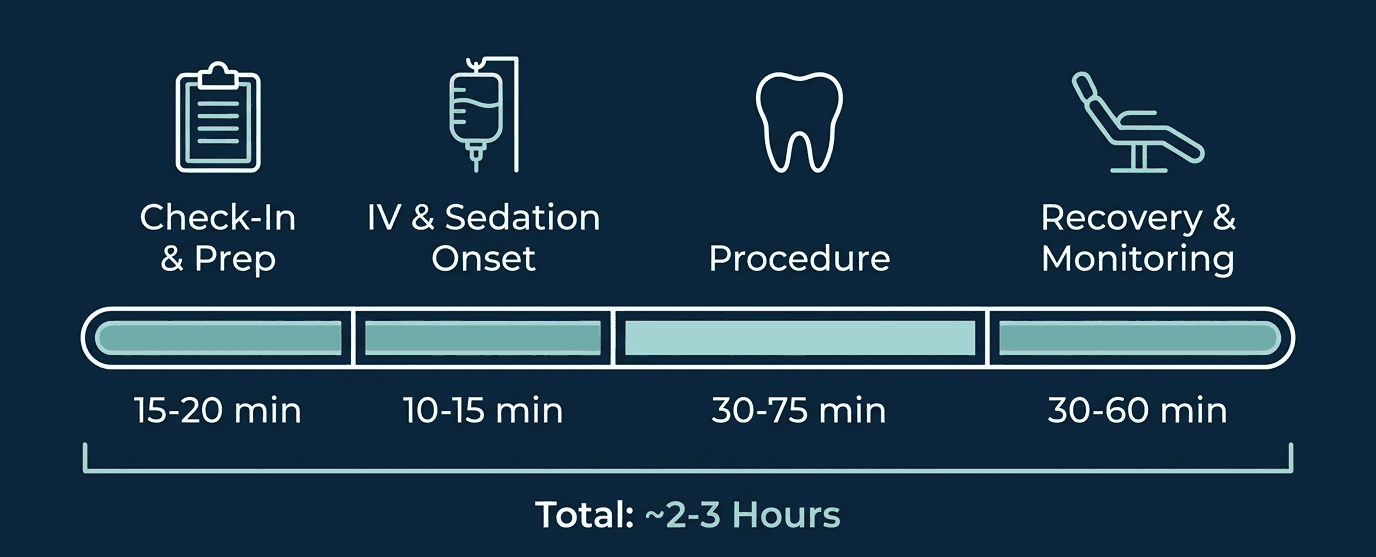
The surgical time is only part of the appointment. Here's the fuller picture of what a wisdom teeth removal day actually involves:
Check-in and pre-op preparation (15–20 minutes): Confirming health history, reviewing the day's plan, and preparing for sedation if applicable.
IV placement and sedation onset (10–15 minutes): If IV sedation is used, the catheter is placed and the medication takes effect within a few minutes.
Surgical procedure (30–75 minutes): As detailed above, depending on the number and complexity of teeth being removed.
Initial recovery and monitoring (30–60 minutes): After IV sedation, patients are monitored in a recovery area until they are stable enough to be discharged with their driver.
Total time at the office: typically 2 to 3 hours from arrival to discharge for a standard all-four wisdom teeth removal with IV sedation. Simple extractions without sedation, or with lighter sedation like nitrous oxide, generally involve a shorter total visit.
How Many Days Off Do You Actually Need?
This is often the more practically important question — and the answer depends on both the complexity of the extraction and the physical demands of what you're returning to.
Desk Work or Remote Work
For simple extractions, many patients feel capable of light desk work or remote work within 1–2 days, though day 2–3 (when swelling typically peaks) can be uncomfortable for concentration-heavy tasks. For more complex impacted extractions, 3–4 days off is a more realistic plan. Video calls may be more comfortable to avoid until visible swelling has reduced, typically by day 4–5.
In-Person Work with Public Interaction
Jobs involving customer-facing interaction, extended talking, or public visibility often warrant an extra day or two beyond the desk-work estimate above — largely due to visible swelling and any temporary difficulty with clear speech in the first few days.
Physically Demanding Work or Manual Labor
Jobs involving heavy lifting, bending, or significant physical exertion should plan for 5–7 days off, sometimes longer for complex surgical cases. Elevated heart rate and physical strain increase bleeding risk and can disrupt the healing clot in the extraction site — this is not a category where an early return is advisable.
School
Most students miss 2–4 days of school for simple extractions and 4–7 days for more complex cases. Missing a Friday and having the weekend as additional recovery time is a commonly used strategy to minimize the total number of school days affected.
Athletes and Physical Activity
Light walking is generally fine after the first day or two. Return to moderate exercise typically happens around day 5–7 for simple cases. Contact sports, heavy weightlifting, or any activity with a risk of impact to the face or jaw should be avoided for a minimum of 1–2 weeks, and longer for more complex surgical cases — both due to bleeding risk from elevated heart rate and the direct risk of trauma to a healing surgical site.
Planning around work or school? Talk to us about your specific case and timeline. Call (801) 370-0050 or book at drwisdomteeth.com.
Factors That Can Extend Recovery Time
A few specific factors tend to push recovery — and therefore days off — toward the longer end of these ranges:
Impacted lower wisdom teeth: These generally involve more surgical complexity and more post-operative swelling than upper or fully erupted teeth.
Removing all four vs. one or two: More extraction sites generally means more overall swelling and a slightly longer initial recovery period, even if each individual site heals at a typical pace.
Age: Younger patients (late teens to mid-twenties) generally experience faster healing than patients in their late thirties and beyond, due to differences in bone density and tissue regeneration rate.
Smoking: Independently associated with slower healing and a significantly higher risk of dry socket, which can add several additional days of discomfort and treatment visits.
Individual healing variation: Even with identical procedures, healing pace varies between individuals. Building in an extra buffer day or two beyond the average estimate is a reasonable planning approach.
Same-Day Consultation and Procedure: Is That an Option?
At Dr. Wisdom Teeth, same-day consultation and procedure appointments are available for patients with straightforward cases who are ready to proceed without a separate initial visit. This can be a useful option for patients trying to minimize total time away from work or school by combining evaluation and treatment into a single day, rather than two separate appointments on different dates.
Not every case is appropriate for same-day treatment — more complex presentations may benefit from a standalone consultation to allow for treatment planning before the surgery date. The team will advise on which approach fits your specific situation.
Frequently Asked Questions
Can I go back to work or school the same day as my procedure?
Generally not recommended, particularly if IV sedation was used. Sedation effects can linger for the rest of the day, coordination and judgment are affected, and driving is not permitted for 24 hours after IV sedation. Plan for the day of the procedure itself to be a rest day regardless of how you feel a few hours afterward.
Does removing just one wisdom tooth mean a much shorter recovery than removing all four?
Somewhat, but the difference is often smaller than expected. A single simple extraction does typically mean less overall swelling and a slightly faster return to normal activity. However, even a single complex impacted extraction can involve a comparable recovery timeline to a full set of four simpler extractions, since complexity of each site matters more than the total count.
How soon after the consultation can I schedule the actual procedure?
This varies based on scheduling availability and whether same-day treatment is appropriate for your case. Many patients are able to schedule their procedure within one to two weeks of their consultation, and same-day options exist for straightforward cases at both Provo and Murray locations.
If I have a big event (wedding, trip, job interview) coming up, how far in advance should I schedule?
A general guideline is 3–4 weeks before any event where you want to look and feel completely normal — this accounts for full resolution of swelling and any residual bruising, not just the return to basic function, which happens faster.
The Bottom Line
The surgery itself is shorter than most people expect — typically 30 to 75 minutes for all four wisdom teeth, with a total appointment time of 2 to 3 hours including preparation and recovery monitoring. Planning days off is the part that benefits from more specific thought: 2–4 days for simple cases and desk-based work, 5–7 days for more complex cases or physically demanding jobs.
If you have a specific event, work schedule, or academic calendar you're planning around, bring it up at your consultation — the team can help tailor a timeline to your actual situation rather than a generic estimate.
Schedule your consultation: drwisdomteeth.com | (801) 370-0050 | Mon–Fri 8am–5pm
Provo: 2230 N University Pkwy #8A | Murray: 5888 S 900 E #101

Written by
Dr. Wisdom Teeth
Resources