
What to Expect at a Wisdom Teeth Consultation: A First-Timer's Guide
Not sure what happens at a wisdom teeth consultation? Here's exactly what to expect — step by step, from X-rays to your removal timeline — so you can walk in prepared.
wisdom teeth consultation what to expect
For many patients, the wisdom teeth consultation is the most anxiety-producing part of the entire process — not because it is difficult, but because it is unfamiliar. Not knowing what will happen when you walk in the door creates more apprehension than the appointment itself typically warrants.
This guide walks through exactly what happens at a wisdom teeth consultation at Dr. Wisdom Teeth — step by step — so you can walk in knowing what to expect, what questions to ask, and what decisions you may be asked to make.
Key Takeaways
A wisdom teeth consultation typically takes 30–45 minutes from check-in to departure.
The appointment includes a health history review, dental X-rays (if not recently taken), a clinical examination, and a treatment recommendation discussion.
You will leave with a clear understanding of your wisdom teeth status, what is recommended, and what the procedure and recovery will involve.
You are not committed to anything at the consultation. It is an information-gathering appointment, not a commitment to surgery.
Same-day appointments are available at both Provo and Murray locations — you do not need a referral.
Before You Arrive: What to Bring
The consultation goes smoothly when you arrive prepared. Here is what to bring:
Your insurance card (if applicable). The front desk team will verify your specific benefits before or during the appointment.
A complete medication list — including all prescriptions, over-the-counter medications, vitamins, and supplements. This is relevant to sedation planning and post-operative pain management.
Relevant medical history — diagnoses, recent surgeries, known allergies, prior anesthesia reactions.
Any recent dental X-rays — if your general dentist has taken a panoramic radiograph within the past 12 months, bringing it (or requesting a digital copy) may avoid redundant imaging.
A parent or guardian for patients under 18. Minor patients require adult accompaniment for treatment consent.
Step by Step: What Happens at the Consultation
Step 1: Check-In and Health History (5–10 Minutes)
You arrive, check in, and are given health history intake forms to complete — either at the front desk or via a pre-appointment digital form sent to you beforehand. These forms cover:
Medical diagnoses and current health conditions
Full medication list
Allergies
Prior dental and surgical experiences
Insurance information
Complete these forms as thoroughly and accurately as possible. The information directly informs both the treatment recommendation and the sedation plan.
Step 2: Dental X-Rays — The Panoramic Radiograph
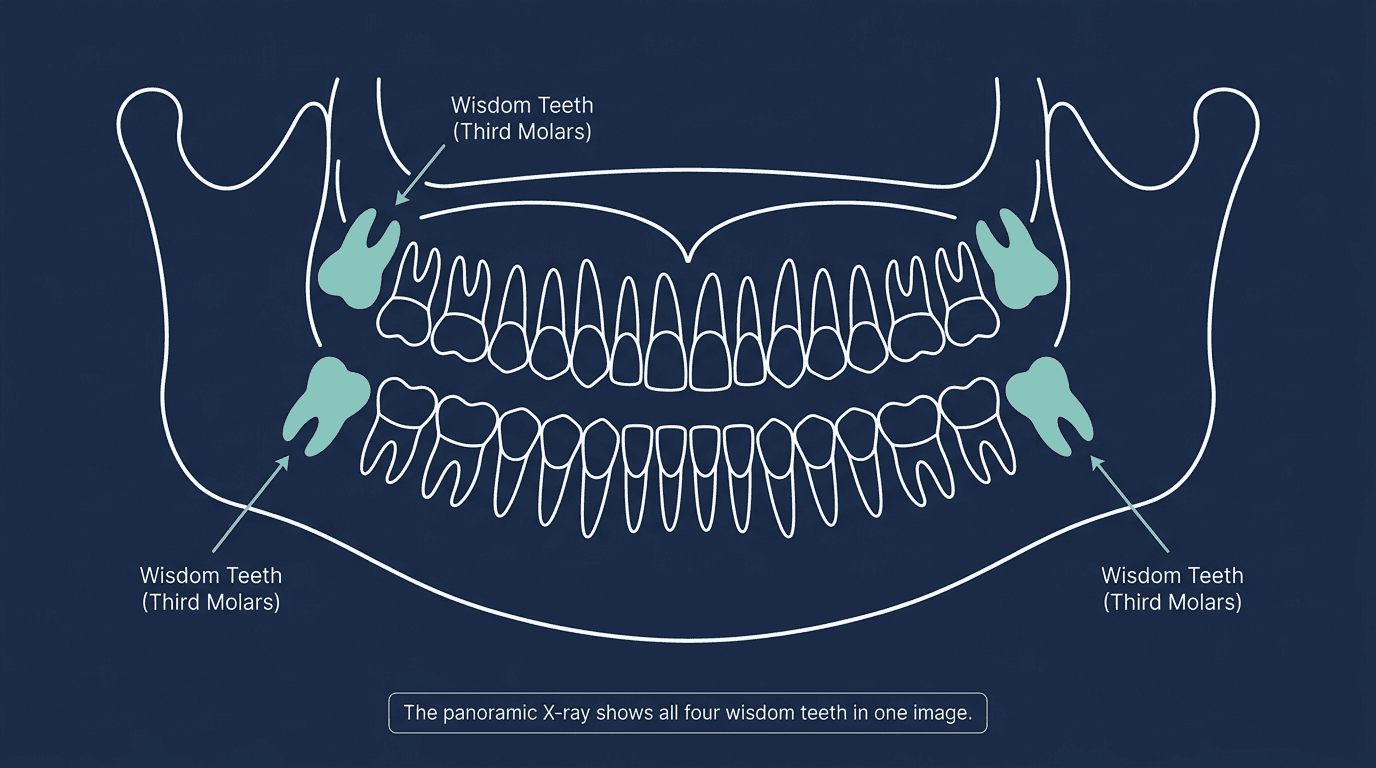
A panoramic X-ray (panorex) is the diagnostic foundation of any wisdom teeth evaluation. This is a single image that shows your entire dental arch — all teeth, roots, jaw anatomy, and surrounding structures — in one view.
If you have a current panoramic X-ray from your general dentist (taken within 12 months), it may be sufficient. If not, one will be taken at the office. Modern digital panoramic X-rays are fast (under 30 seconds), involve minimal radiation, and do not require anything to be placed inside your mouth beyond a bite block to stabilize your head position.
What the X-ray reveals about your wisdom teeth:
Whether all four wisdom teeth are present (some people have fewer than four; a small percentage have none)
Current position and angulation of each tooth
Stage of root development
Proximity to the inferior alveolar nerve (for lower wisdom teeth)
Proximity to the maxillary sinus (for upper wisdom teeth)
Presence of any associated cysts, pathology, or root resorption of adjacent teeth
Step 3: Clinical Examination (5–10 Minutes)
After reviewing the X-rays, the clinician performs a brief oral examination. This may include:
Visual and manual inspection of the back of the mouth where wisdom teeth are located
Assessment of any visible eruption, gum tissue condition, or signs of pericoronitis (inflammation around a partially erupted tooth)
Evaluation of jaw opening and any existing tenderness
Review of overall dental health as it relates to the wisdom teeth situation
This examination is brief and non-invasive. No drilling, no injections, no discomfort beyond whatever existing tenderness you arrived with.
Step 4: Treatment Discussion and Recommendation (10–15 Minutes)
This is the most important part of the consultation. The clinician reviews the X-ray findings and examination with you directly — explaining what they see in plain language.
The discussion typically covers:
The current status of each wisdom tooth — erupted, partially erupted, fully impacted, or not yet visible
Whether removal is recommended, and if so, the clinical reasoning
The type of extraction anticipated for each tooth — simple or surgical — and what that means for the procedure
Sedation options and a recommendation based on the case complexity and patient preferences
The PRF protocol and how it is incorporated
General recovery timeline and what to expect
If removal is recommended, you will receive a clear cost estimate that reflects your specific case, including what insurance will cover (if applicable) and the expected out-of-pocket amount.
Step 5: Scheduling (5 Minutes)
If you are ready to move forward after the consultation, the scheduling team books your procedure appointment. If you want time to review your options, get a second opinion, or verify insurance coverage before committing, that is completely appropriate. There is no pressure to schedule at the consultation.
Same-day appointments — consultation and procedure on the same day — are available for patients who prefer this approach and for whom it is clinically appropriate.
Ready to find out where your wisdom teeth stand? Book your consultation at drwisdomteeth.com or call (801) 370-0050. No referral needed.
Questions to Ask at Your Consultation
Come prepared with questions. The consultation is your opportunity to understand your specific situation completely before making any decisions. Here are the most useful questions to ask:
Are all four wisdom teeth present, or do I have fewer?
Are any of them impacted, and if so, what type and severity of impaction?
What type of extraction does each tooth require — simple or surgical?
What is my dry socket risk profile, and how does PRF reduce it in my case?
What sedation option do you recommend for my procedure, and why?
How long will the procedure take?
What is the recovery timeline for my specific case?
Is there anything about my medical history or medications that changes the approach?
What happens if I choose not to remove them right now?
What the Consultation Cannot Tell You
A consultation provides the most complete picture available without surgery — but it has inherent limits. Dental X-rays show two-dimensional representations of three-dimensional anatomy. Some aspects of root geometry, proximity to nerve structures, and bone density only become fully clear during the procedure itself.
This is why experienced surgeons communicate ranges — 'this will likely be straightforward, though the root curvature on X-ray suggests it could be more involved' — rather than guaranteeing exact outcomes. Appropriate surgical judgment includes updating the approach in real time based on what is encountered.
For Parents: Bringing Your Teenager
Many wisdom teeth consultations involve teenagers between 16 and 21. A few things parents frequently ask:
Does my child need to be present? Yes. The clinical examination and treatment discussion are conducted with the patient directly. Parents are welcome to be present throughout.
Will the recommendation definitely be to remove them? Not necessarily. The consultation finds out what is happening. Some teenagers' wisdom teeth are well-positioned and monitored without immediate removal. Others clearly warrant proactive extraction.
Can my child drive themselves home after the consultation? Yes. The consultation involves no sedation or anesthesia. The procedure appointment is different — a driver is required when IV sedation is used.
Is 16 too young to be evaluated? No. 16–17 is an appropriate age for a first panoramic evaluation, particularly if the teenager is experiencing back-of-mouth discomfort or an orthodontist has flagged wisdom tooth positioning as a concern.
Frequently Asked Questions
How long does a wisdom teeth consultation take?
Most consultations at Dr. Wisdom Teeth run 30–45 minutes from check-in to checkout. This includes intake, X-rays, examination, and the treatment discussion. Occasionally a more complex case or a patient with many questions will run slightly longer — that additional time is never rushed.
Do I need a referral from my dentist?
No. Patients can self-refer directly to Dr. Wisdom Teeth. Many patients come after a general dentist has suggested an evaluation, but a formal referral is not required.
Will I know at the consultation if I definitely need surgery?
In most cases, yes. The combination of a panoramic X-ray and clinical examination gives a clear picture of whether removal is indicated, what type of procedure is involved, and what the recommended timeline is. Occasionally, additional imaging (such as a CBCT scan for complex nerve proximity cases) is ordered before final surgical planning.
What if I can't afford surgery right now? Can I still get a consultation?
Yes. The consultation provides an accurate picture of your situation and a clear cost estimate. There is no obligation to schedule surgery at or after the consultation. Knowing what you're dealing with — and what it will cost — is valuable even if you need time before proceeding.
Can both the consultation and surgery happen on the same day?
Yes, when clinically appropriate. Some patients prefer the efficiency of a single visit. Same-day consultation-and-procedure scheduling is available at Dr. Wisdom Teeth for straightforward cases. Patients with more complex presentations may benefit from a standalone consultation to allow for treatment planning and pre-operative preparation before the surgery day.
The Bottom Line
A wisdom teeth consultation is a 30–45 minute appointment that tells you exactly where you stand. You'll leave with current X-rays, a clear assessment of your wisdom teeth status, a specific recommendation, a cost estimate, and answers to your questions. There is no pressure to commit to anything.
The uncertainty of not knowing is almost always worse than the information itself. Booking the consultation is the step that converts 'I should probably deal with my wisdom teeth' into an actual plan.
Book your consultation — no referral needed: drwisdomteeth.com | (801) 370-0050 | Mon–Fri 8am–5pmProvo: 2230 N University Pkwy #8A | Murray: 5888 S 900 E #101

Written by
Dr. Wisdom Teeth
Resources