Oral Surgeon vs. General Dentist for Wisdom Teeth: What's the Actual Difference?
Should you get wisdom teeth removed by an oral surgeon or your general dentist? Learn the real differences in training, scope, sedation options, and outcomes — before you book.
oral surgeon vs dentist wisdom teeth removal
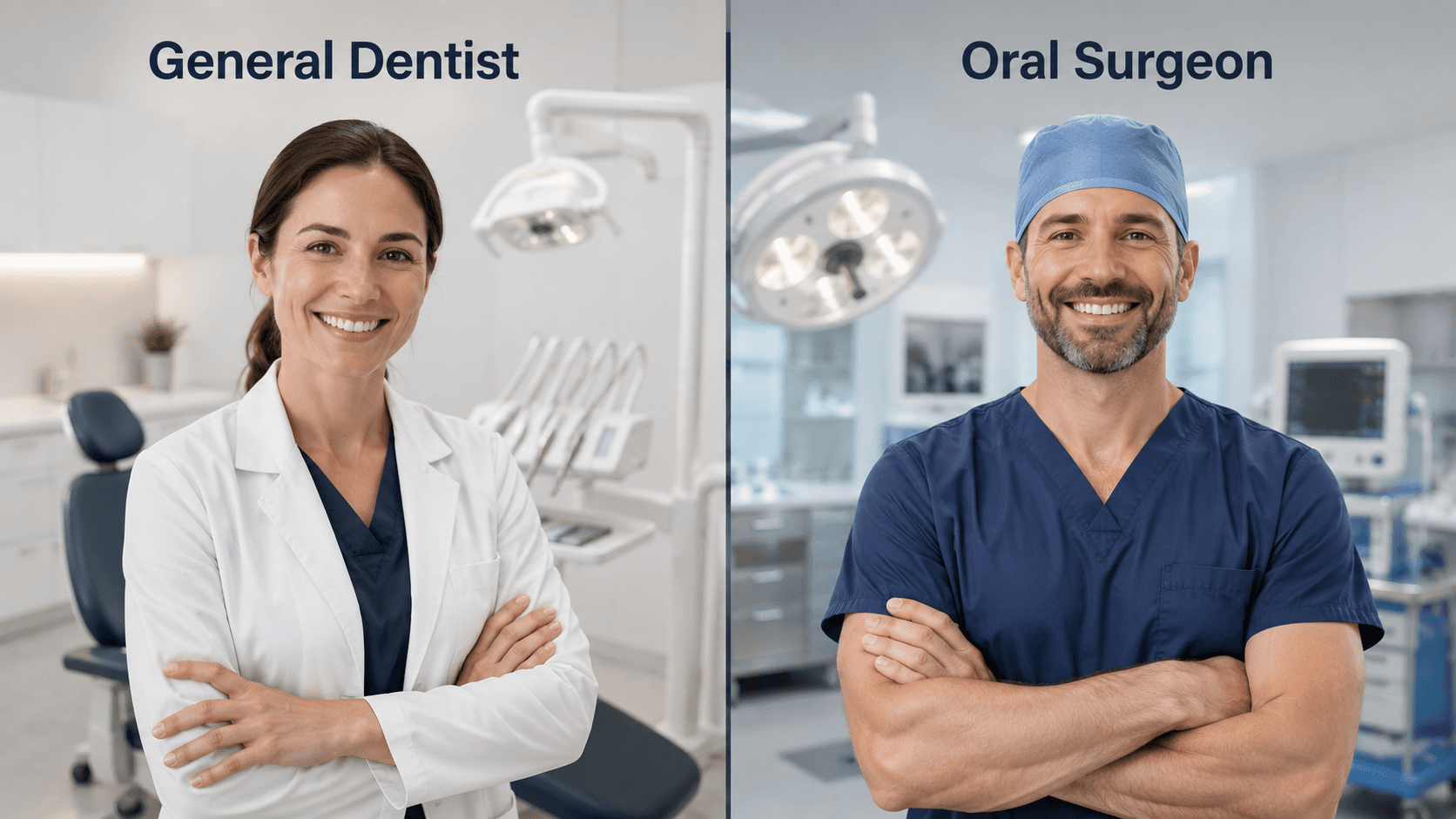
When a dentist tells you it’s time to remove your wisdom teeth, you’ll typically be given two paths: have it done at the general dental office, or get a referral to an oral surgeon. Most patients accept whichever recommendation comes first. Few patients understand what they’re actually choosing between — and why the distinction matters, especially for complex cases.
This article breaks down the real differences in training, tools, sedation capability, and clinical scope between a general dentist and an oral and maxillofacial surgeon (OMS) — and explains why wisdom teeth removal, particularly for impacted third molars, is a procedure for which professional training was specifically designed.
Key Takeaways
General dentists can legally perform simple wisdom teeth extractions in most states, but their training in oral surgery is limited compared to a professional.
Oral and maxillofacial surgeons complete 4–6 years of hospital-based surgical residency after dental school — specifically covering complex extractions, sedation administration, and surgical complications.
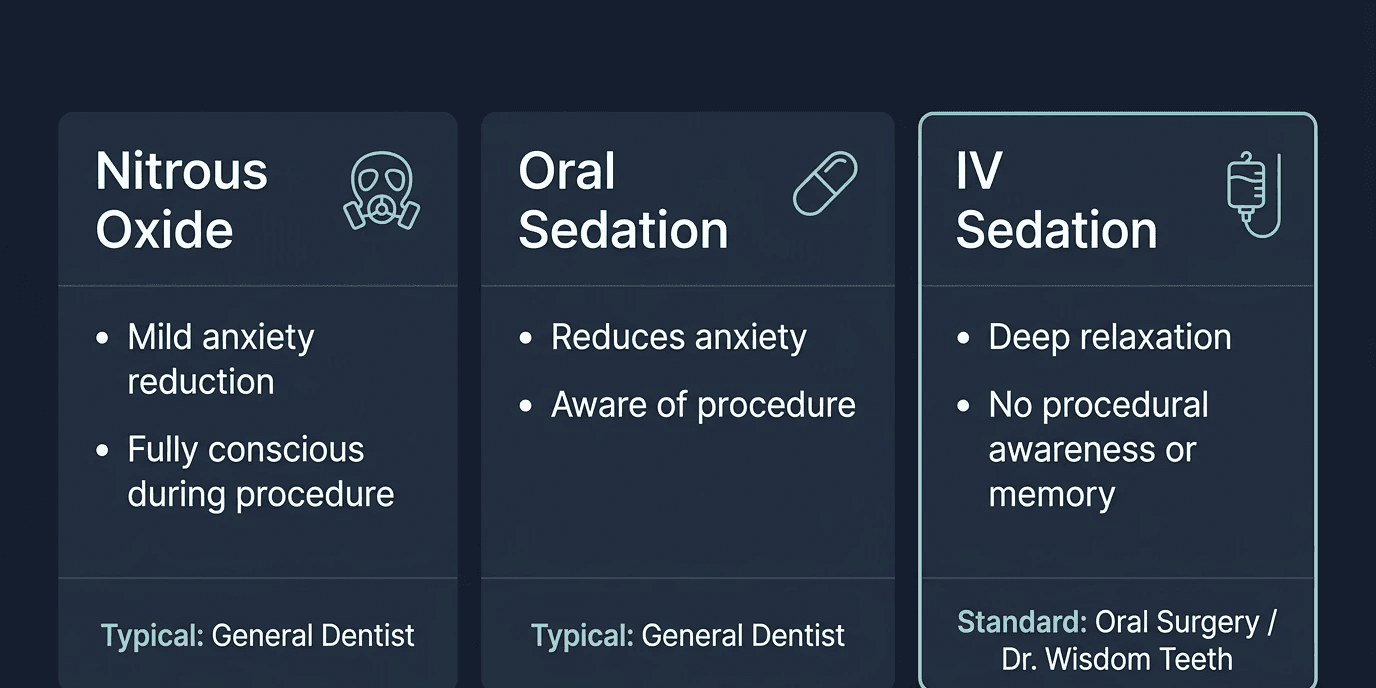
IV sedation is standard at oral surgery practices. Most general dental offices offer only nitrous oxide or oral sedation, if any sedation at all.
Impacted wisdom teeth — the most common presentation — require surgical techniques that are within the core scope of an oral surgeon and outside the routine practice of most general dentists.
Dr. Wisdom Teeth is a specialized practice focused exclusively on wisdom teeth removal, offering oral surgery expertise, IV sedation, and PRF therapy at both Provo and Murray locations.
Training: What the Difference Actually Looks Like
General Dentist
A general dentist completes four years of dental school after a bachelor’s degree. Dental school curriculum includes rotations in oral surgery, but the depth and volume of surgical training varies significantly by program. Most general dentists graduate having performed dozens of simple extractions — primarily single-rooted, fully erupted teeth.
After graduation, some general dentists pursue continuing education courses in oral surgery or extraction techniques. These courses range from a single weekend to multi-week programs. The quality and clinical volume provided varies considerably.
General dentists who perform wisdom teeth removal regularly — and do so competently — exist. But ‘able to perform simple extractions’ and ‘trained to manage complex impaction surgery and its complications’ are meaningfully different categories.
Oral and Maxillofacial Surgeon (OMS)
An oral and maxillofacial surgeon completes dental school followed by a 4–6 year hospital-based surgical residency. This residency is structured like a medical surgical residency — not a dental continuing education course.
During the OMS residency, surgeons:
Rotate through general surgery, anesthesiology, internal medicine, emergency medicine, and plastic surgery
Manage acute surgical complications and emergencies in a hospital setting
Perform hundreds of wisdom teeth extractions across the full spectrum — simple erupted to deeply impacted, horizontally positioned, and nerve-adjacent cases
Complete thousands of hours of monitored anesthesia administration, including IV sedation and general anesthesia
In 6-year programs, also earn an MD in addition to their DDS/DMD
Wisdom teeth removal — particularly for impacted lower third molars — is one of the foundational procedures OMS training is designed around. It is not an edge case they handle occasionally; it is a core competency.
Sedation: The Most Clinically Significant Practical Difference
For many patients, this is the deciding factor. Anxiety about wisdom teeth removal is extremely common — studies show a majority of patients experience significant pre-procedural fear. Sedation determines whether the experience is genuinely comfortable or simply tolerable.
What General Dentists Typically Offer
Nitrous oxide (laughing gas): Reduces anxiety and edge during the procedure. You remain fully conscious and aware. Effective for mild anxiety; insufficient for significant dental phobia or complex surgical cases.
Oral sedation (pill-based): A prescription anxiolytic taken before the appointment. Reduces anxiety but does not provide procedural amnesia or deep relaxation. You remain awake and aware of the procedure.
IV sedation: Offered by some general dentists with additional certification — but requires specific state licensing, equipment, and monitoring protocols. Most general dental offices do not offer this.
What Oral Surgeons Offer
IV sedation — deep, medically administered sedation — is the standard of care at oral surgery practices. It is what OMS residency training specifically prepares surgeons and their clinical teams to administer and monitor safely.
IV sedation delivers a deeply relaxed, semi-conscious state in which you have little to no awareness of the procedure and typically no memory of it afterward. It is the option most patients who describe their wisdom teeth removal as ‘fine’ or ‘easy’ received. It is administered through a small IV catheter and monitored continuously throughout the procedure with pulse oximetry, blood pressure monitoring, and cardiac monitoring.
At Dr. Wisdom Teeth, IV sedation is a standard offering at both locations — not a premium add-on requiring a separate professional. The clinical team is trained and licensed in IV sedation administration specific to the oral surgery context.
Scope of Surgery: Simple vs. Surgical Extractions
Simple Erupted Extractions
A fully erupted, upright wisdom tooth with a simple root structure can be removed with standard extraction forceps and minimal bone manipulation. This is within the practical capability of a general dentist with extraction experience.
However, even ‘simple’ wisdom teeth extractions benefit from IV sedation capability and the equipment and training to manage unexpected complications — a tooth that fractures mid-extraction, a root that curves unexpectedly, or an adjacent structure that is closer than the preoperative X-ray suggested.
Impacted and Surgical Extractions
The majority of wisdom teeth that require removal are impacted — partially or fully enclosed in bone, angled incorrectly, or both. Removing an impacted tooth requires:
Incision of the overlying gum tissue
Controlled removal of surrounding bone using a surgical handpiece
Sectioning (dividing) the tooth into multiple pieces for staged removal
Socket curettage and irrigation
Suture placement and closure
This is a surgical procedure. It requires surgical training, surgical instruments, and the ability to manage surgical complications — including bleeding, nerve proximity, and the rare but real possibility of maxillary sinus communication for upper wisdom teeth.
These are the cases for which oral surgery training exists. They are not within the routine scope of general dental practice, and attempting them without surgical residency training increases the risk of complications, root fractures requiring secondary procedures, and inferior patient outcomes.
Why a Focused Specialty Practice Is Different from Both
There is a category beyond ‘general dentist’ and ‘oral surgeon in a multi-specialty practice’ — a practice that does one thing, and does it every day.
Dr. Wisdom Teeth is exclusively focused on wisdom teeth removal. Not general oral surgery, not implants, not jaw reconstruction — wisdom teeth. The entire clinical setup, staff training, scheduling model, pricing structure, and post-operative support system is built around this single procedure.
That specialization has concrete implications:
The clinical team performs wisdom teeth procedures daily — not occasionally between other types of cases.
IV sedation protocols are refined specifically for this procedure and this patient population.
PRF is included in every case — not offered as an elective upgrade — because it is the clinical standard for optimal healing outcomes.
Pricing is transparent and consistent — because there is no guesswork about what a single-focus practice costs.
Post-operative support is purpose-built — the team knows the recovery timeline, the warning signs, and the treatment protocol for complications because those are the only post-op scenarios they manage.
Ready to work with a team that does this every day? Book your appointment at drwisdomteeth.com or call (801) 370-0050 — Mon–Fri 8am–5pm.
When a General Dentist Referral Is the Right Call
In the interest of accuracy: there are cases where a general dentist appropriately performs wisdom teeth removal, and cases where the dentist appropriately refers.
Simple, fully erupted, upright wisdom teeth with straightforward anatomy in a patient with no significant anxiety or medical complexity: a competent general dentist with extraction experience can perform this safely.
Any impacted wisdom tooth — partial or full bony impaction, horizontal or mesial angulation — warrants referral to an oral surgeon or professional practice.
Patients with significant dental anxiety who require IV sedation for a comfortable experience should be seen at a practice that offers and routinely administers IV sedation.
Patients with complex medical histories (anticoagulant use, cardiovascular conditions, immunosuppression) are best managed in a surgical setting where medical complications can be anticipated and addressed.
A dentist who refers impacted wisdom tooth cases to an oral surgeon is practicing appropriately. A dentist who proceeds with a complex impacted surgical case outside their training and equipment capability is not — regardless of their confidence.
Questions to Ask Before You Commit to Any Provider
How many wisdom teeth extractions do you perform per week? Per month?
Is IV sedation available at your office? Who administers and monitors it?
If my tooth is impacted, do you perform the surgical extraction here or refer to a professional?
What happens if there is a complication during the procedure — how is it managed?
Is PRF included, and if so, how is it prepared and placed?
Frequently Asked Questions
Is it cheaper to have wisdom teeth removed by a general dentist?
Sometimes — but the comparison is incomplete without accounting for what is included. A general dental extraction without IV sedation and without PRF may cost less than a professional procedure that includes both. Whether that difference reflects a lower cost or simply fewer services depends entirely on what the specific quote includes. At Dr. Wisdom Teeth, pricing is transparent and all-inclusive — no line items added at checkout.
My general dentist said they can do it. Should I trust that?
Evaluate the specifics. Are your wisdom teeth fully erupted and upright, or impacted? Does the dentist offer IV sedation if you want it? How many wisdom teeth extractions do they perform regularly? A fully erupted, simple wisdom tooth removed by an experienced general dentist is a reasonable option. An impacted molar requiring surgical extraction is a different conversation.
Do I need a referral to see an oral surgeon?
No. Patients can self-refer to an oral surgery practice directly. If your general dentist has not mentioned wisdom teeth evaluation and you are 17–25 and have not had them assessed, you can call Dr. Wisdom Teeth directly for a consultation without waiting for a referral.
What is an OMS residency, and how long is it?
An Oral and Maxillofacial Surgery (OMS) residency is a 4–6 year hospital-based surgical training program completed after dental school. It covers the full scope of oral and facial surgery — from wisdom teeth and implants to facial trauma, jaw reconstruction, and tumor surgery. 6-year programs include an additional year to earn an MD degree alongside the surgical training.
The Bottom Line
The choice between a general dentist and an oral surgeon for wisdom teeth removal is not primarily about cost or convenience — it is about matching the complexity of the procedure to the training and capabilities of the provider. For simple, erupted wisdom teeth in low-anxiety patients, a general dentist with extraction experience is a reasonable option. For impacted wisdom teeth, patients who want IV sedation, or anyone who simply wants the procedure done by a team that has done it thousands of times before, an oral surgery professional is the appropriate choice.
Dr. Wisdom Teeth exists specifically for patients who want that level of focused expertise — and same-day appointments are available at both Provo and Murray.
Schedule your consultation: drwisdomteeth.com | (801) 370-0050 | Mon–Fri 8am–5pmProvo: 2230 N University Pkwy #8A | Murray: 5888 S 900 E #101
Written by
Dr. Wisdom Teeth
Resources