IV Sedation for Wisdom Teeth Removal: What to Expect Before, During, and After
Nervous about wisdom teeth removal? Learn exactly how IV sedation works, who qualifies, what it costs, and why it's the safest option for a pain-free procedure in Utah.
Removal Process
If the words wisdom teeth removal make your stomach drop, you're not alone. Anxiety about the procedure — the needles, the sounds, the idea of being awake while someone works on your mouth — is one of the most common reasons people delay treatment they know they need. IV sedation exists specifically to remove that barrier. This article explains exactly how it works, what makes it safe, who it's right for, and what to expect at each stage of your appointment.
Key Takeaways
IV sedation puts you in a deeply relaxed, semi-conscious state — you won't feel pain and you likely won't remember the procedure.
It is administered and monitored by trained clinical staff throughout the entire procedure.
IV sedation is different from general anesthesia: you breathe on your own and can respond to simple prompts.
Most healthy adults and teenagers qualify; a brief pre-op screening determines eligibility.
Recovery from IV sedation takes a few hours — you will need a driver home.
At Dr. Wisdom Teeth, IV sedation is a standard sedation option included as part of the procedure — not a separate add-on you have to negotiate for.
What Is IV Sedation — and What It Isn't
IV sedation (intravenous sedation) delivers medication directly into your bloodstream through a small catheter placed in your arm. The result is a calm, deeply relaxed state where you remain technically conscious but fully unaware of what's happening around you.
Here's what that actually means in practice:
You will not feel pain during the procedure.
You will likely have little to no memory of the appointment afterward.
You breathe on your own the entire time — no breathing tube is required.
You can respond to simple verbal instructions if needed, but you won't be 'awake' in any meaningful sense.
IV Sedation vs. General Anesthesia
These are not the same thing. General anesthesia renders you completely unconscious and requires airway management (intubation). IV sedation is moderate-to-deep sedation — you stay in a controlled, relaxed state without losing your protective airway reflexes. For wisdom teeth removal in an outpatient setting, IV sedation is the clinical standard precisely because it provides profound comfort without the additional risk profile of full general anesthesia.
IV Sedation vs. Nitrous Oxide (Laughing Gas)
Nitrous oxide takes the edge off anxiety but leaves you fully conscious and aware of everything happening. Some patients do fine with it. But for patients with significant dental anxiety, needle phobia, or complex extractions, nitrous alone often isn't enough. IV sedation produces a much deeper level of comfort and reliably eliminates procedural awareness.
How IV Sedation Works: Step by Step
Step 1: Pre-Op Screening
Before your procedure date, your clinical team reviews your health history to confirm you're a good candidate for IV sedation. They'll ask about current medications, allergies, prior anesthesia reactions, and any relevant medical conditions. This is also when you receive pre-op instructions — the most important of which is the fasting requirement.
Fasting rule: Nothing to eat or drink for at least 6 hours before your procedure (water and prescribed medications with a small sip of water are typically the only exceptions). This is a safety requirement, not a suggestion. Having food in your stomach significantly increases the risk of nausea and aspiration during sedation. Your appointment will be rescheduled if this is not followed.
Step 2: IV Placement
When you're seated in the procedure room, a small IV catheter is placed — typically in your left arm. This is quick and causes minimal discomfort. The IV line remains in place throughout the entire procedure so medication can be adjusted precisely in real time.
Step 3: Sedation Administration
Your clinical team administers the sedation medication through the IV. Within minutes, you'll feel a wave of calm. Most patients describe it as a pleasant drowsiness. By the time the surgeon begins working, you will be in a deep sedative state. Local anesthesia is also administered to the surgical site to ensure there is no pain signal, even at the sedation depth used.
Step 4: Continuous Monitoring Throughout
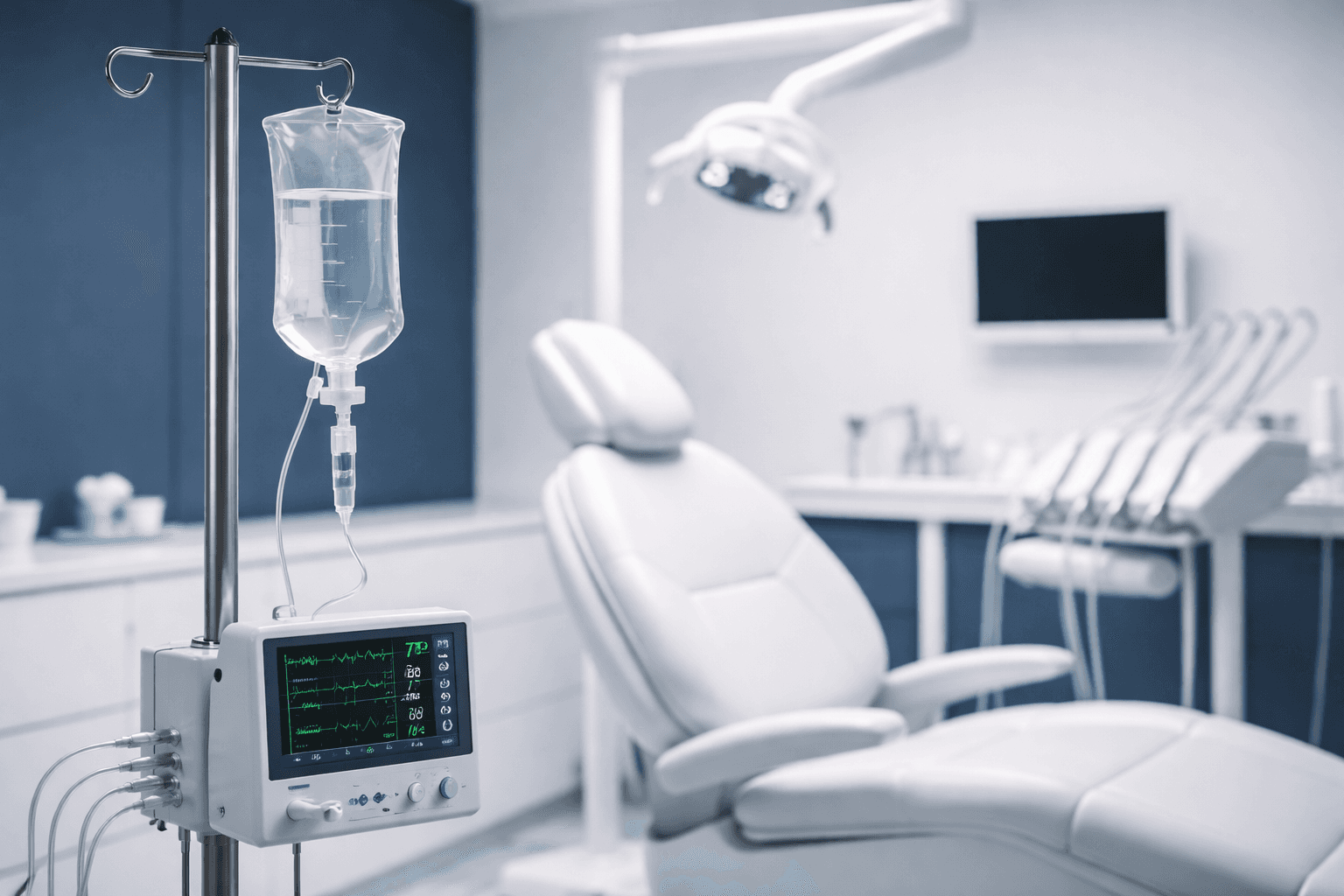
This is where the safety foundation lives. Throughout your procedure, a trained clinical team monitors your vital signs — oxygen saturation, heart rate, blood pressure, and respiratory rate — using modern monitoring equipment. The team is trained and licensed in sedation administration and emergency response. You are never left unmonitored.
Step 5: Recovery
After the extractions are complete, the sedation wears off gradually in a recovery area. Most patients feel groggy and somewhat confused initially — this is normal and expected. You will need a responsible adult to drive you home; driving after IV sedation is not permitted, and no exceptions are made. Plan to rest for the remainder of the day.
Ready to schedule with sedation? Call (801) 370-0050 or book your appointment online at drwisdomteeth.com — same-day appointments are available.
Who Is a Good Candidate for IV Sedation?
Most healthy adults and teenagers qualify for IV sedation wisdom teeth removal. You are likely a strong candidate if any of the following apply:
You have significant dental anxiety or a phobia of dental procedures.
You've had a previous traumatic dental experience.
You have a strong gag reflex that makes oral procedures difficult.
You are having multiple wisdom teeth removed in one session.
You have impacted wisdom teeth requiring surgical extraction.
You simply want the most comfortable experience possible.
Who Should Discuss Their Situation Further
Certain medical conditions or medications may require additional evaluation before IV sedation is appropriate. This includes patients who are pregnant, have significant cardiovascular conditions, have had adverse reactions to anesthesia in the past, or are taking specific medications that interact with sedative agents. Your clinical team will review these factors during pre-op screening.
Is IV Sedation Safe?
Yes — when administered by trained, licensed clinical staff in a properly equipped facility, IV sedation for wisdom teeth removal has an established and well-documented safety record.
At Dr. Wisdom Teeth, the clinical team holds the training, licensing, and experience required to administer and monitor IV sedation safely. The office facilities and staff are inspected regularly on behalf of the State Board of Dental Examiners. Modern monitoring equipment is used throughout every procedure.
The Risks Are Real but Rare
No medical procedure is entirely without risk. Known complications from IV sedation include nausea, dizziness, temporary grogginess, and in rare cases, adverse medication reactions. Serious complications are uncommon in outpatient wisdom teeth removal when proper fasting guidelines are followed and screening has been completed. Your clinical team is trained to recognize and respond to complications if they occur.
What PRF Adds to the Recovery Equation
At Dr. Wisdom Teeth, Platelet-Rich Fibrin (PRF) is included as a standard part of every procedure — not an optional upgrade. PRF is derived from your own blood, processed chairside, and placed directly in the extraction socket at the time of surgery. It supports clot stabilization and tissue regeneration, meaningfully reducing the risk of dry socket — one of the most painful post-operative complications of wisdom teeth removal. The combination of IV sedation for a smooth procedure and PRF for a faster recovery is a deliberate clinical choice, not a marketing point.
What to Expect After IV Sedation: The Recovery Timeline
Hours 1–4: The Fog
Immediately after the procedure, expect grogginess, some confusion, and impaired coordination. This is the sedation wearing off. You cannot drive. Rest at home, keep your head slightly elevated, and follow the post-op instructions your clinical team provides.
Day 1: Rest and Soft Foods
Start with clear liquids and progress to soft foods as tolerated. Avoid dairy products on the day of surgery (they can contribute to nausea). No straws — the suction creates negative pressure that can dislodge the blood clot forming in the extraction site. No smoking. Take prescribed medications as directed.
Days 2–3: Swelling Peaks
Swelling typically reaches its maximum on day 2–3 before beginning to resolve. Cold compresses applied during the first 24 hours help reduce swelling; warm compresses can be used afterward. Some bruising around the jaw is normal.
Days 4–7: Gradual Improvement
Most patients see significant improvement in comfort by day 4–5. By day 7–10, the majority of patients feel largely back to normal. If you are experiencing worsening pain after day 3, signs of infection (increasing swelling, fever, foul taste), or visible bone in the socket, contact your surgeon immediately — these can signal dry socket or infection, both of which are treatable when caught early.
Sedation and Cost: What You Should Know
IV sedation is a meaningful part of what you're paying for when you choose a specialized wisdom teeth practice over a general dentist. At a general dental office, sedation is often an add-on that drives significant additional cost. At Dr. Wisdom Teeth, the pricing structure is built to be transparent upfront — you know what's included before your appointment.
If you have dental insurance, coverage for wisdom teeth removal typically ranges from 50% to 80% of the procedure cost. Coverage for sedation varies by plan — some plans cover it in full alongside the surgical benefit, others cover it partially. The office team can help verify your specific coverage before your appointment so there are no surprises.
For patients without insurance, Dr. Wisdom Teeth offers a clear price structure with all components outlined — no hidden fees, no discovering costs on the day of surgery.
Questions about cost or insurance? Call (801) 370-0050 — Monday through Friday, 8am to 5pm. The team will verify your benefits before your appointment.
Frequently Asked Questions
Will I be completely unconscious during IV sedation?
Not in the traditional sense. IV sedation produces a deeply relaxed, semi-conscious state. You breathe on your own and can respond to simple prompts. Most patients have little to no memory of the procedure afterward, which is why it often feels like 'being out' even though you weren't.
Does the IV needle hurt?
IV placement is a quick, minor procedure — a small pinch at most. Most patients report it as significantly less uncomfortable than they anticipated. The clinical team works to make it as smooth as possible.
Can I eat before my sedation appointment?
No. You must fast for at least 6 hours before your procedure. Nothing to eat or drink — not even coffee. Prescription medications with a small sip of water are typically allowed; confirm specifics with your clinical team. Your appointment will be rescheduled if you have not fasted.
How long does the sedation last after the procedure?
Most of the sedation clears within 2–4 hours, but you may feel groggy or foggy for the rest of the day. You cannot drive for 24 hours after receiving IV sedation. Plan to have a responsible adult with you for the day.
My teenager is anxious about surgery. Is IV sedation safe for them?
IV sedation is routinely and safely used for adolescent patients. If a parent or guardian accompanies minors to the office and remains during the procedure. The clinical team will review your teenager's health history during pre-op screening to confirm they are a good candidate.
What happens if I move or wake up during the procedure?
The level of sedation administered is calibrated to prevent this. Your vital signs are monitored throughout and the sedation can be adjusted in real time by the clinical team. This is why IV administration — which allows precise, immediate dosing adjustments — is preferred over oral sedation for complex procedures.
The Bottom Line
IV sedation removes the single biggest reason people avoid wisdom teeth removal: fear of the experience. If anxiety has kept you from scheduling a procedure you know you need, sedation changes that equation entirely. You arrive, you're comfortable, and the next thing you're aware of is being in recovery.
At Dr. Wisdom Teeth, IV sedation is a core part of the practice — not an afterthought. Two locations in Provo and Murray serve patients across Utah with same-day appointments available.
Provo Office: 2230 N University Pkwy #8A, Provo, UT 84604
Murray Office: 5888 S 900 E #101, Murray, UT 84121

Written by
Dr. Wisdom Teeth
Resources