Dental Anxiety and Wisdom Teeth Removal: How to Actually Get Through It
Dental anxiety is the #1 reason people delay wisdom teeth removal. Learn what actually helps — from IV sedation to what to tell your surgeon — and why fear no longer has to be the reason you wait.
dental anxiety wisdom teeth removal
If you've been putting off wisdom teeth removal because the idea of the procedure makes you genuinely anxious — or if you've canceled an appointment more than once — you are not unusual. Dental anxiety is one of the most common forms of medical fear, affecting an estimated 36% of adults to some degree, with approximately 12% experiencing dental phobia significant enough to avoid necessary care entirely.
The problem is not the fear itself. Fear is a normal human response to anticipated pain, loss of control, and unfamiliar situations. The problem is what the fear costs — delayed treatment, worsening impaction, preventable complications — when it becomes the reason to keep not acting.
This article is for the patient who knows they need their wisdom teeth removed and keeps not doing it because of anxiety. It explains what actually makes the experience manageable, what sedation options exist and what they genuinely feel like, and what to tell your surgical team so that your specific fears can be addressed.
Key Takeaways
Dental anxiety about wisdom teeth removal is extremely common — you are not unusual or weak for feeling it.
IV sedation eliminates procedural awareness and memory for most patients. The experience under IV sedation is genuinely not what anxious patients are imagining.
Communicating your anxiety clearly to the surgical team — before and on the day of the procedure — directly changes how the team interacts with you.
Several pre-procedure strategies (preparation, breathing techniques, music) have documented effectiveness in reducing pre-operative anxiety.
The most common report from anxious patients after a sedated procedure is: 'That was so much easier than I expected.'
Understanding What You're Actually Afraid Of
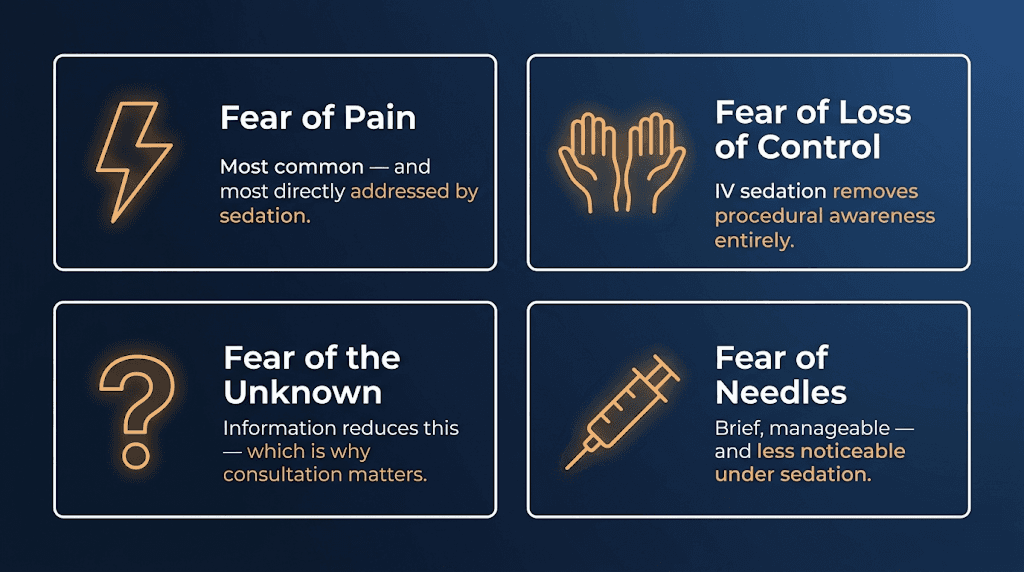
Dental anxiety is not monolithic. Most patients are afraid of a specific combination of things, and identifying what drives yours makes it easier to address. Common components:
Fear of Pain
This is the most universal component of dental anxiety. It typically originates from a previous painful dental experience — or from vivid stories shared by others. The key clinical fact: with IV sedation and local anesthesia, you will not feel pain during the procedure. Local anesthesia numbs the surgical site completely. IV sedation removes your awareness of and memory of the procedure. Pain during a properly sedated wisdom teeth removal is not the experience.
Post-operative pain is different — it is real and should be anticipated and managed with the medications provided. But procedural pain under sedation is not what you think it is.
Fear of Loss of Control
Being reclined in a chair, unable to see what is happening, with instruments in your mouth while someone works — this creates a profound sense of vulnerability. For patients with a history of trauma, this specific dynamic can trigger intense anxiety regardless of the clinical context.
IV sedation addresses this directly: under sedation, the awareness of what is happening — the sounds, sensations, and sense of time — is suppressed. Many patients describe it as 'blinking and it being over.' The experience of loss of control is largely replaced by the experience of absence.
Fear of the Unknown
For patients who have never had oral surgery, the imagination fills in details — usually significantly worse than the reality. This specific fear responds well to information. Understanding exactly what will happen, in what order, and what each sensation (or absence of sensation) means reduces the power of the unknown considerably.
This is one of the primary functions of the consultation appointment — not just clinical assessment, but demystification.
Fear of Needles
Needle phobia is extremely common and is a specific, identifiable component of dental anxiety for many patients. The IV needle and the local anesthesia injection are the two needle events in wisdom teeth removal. Both can be addressed:
IV placement: A small catheter in the arm. Takes seconds. Most patients rate it as significantly less uncomfortable than anticipated.
Local anesthesia injection: Topical numbing gel is applied to the gum tissue before the injection. The injection is brief. Under IV sedation, most patients have no memory of either.
Past Traumatic Dental Experiences
Patients who experienced pain, dismissiveness, or a loss of control in a previous dental setting often carry that experience into every subsequent appointment. This is a documented phenomenon — post-traumatic dental anxiety — and it is not irrational. If this applies to you, naming it explicitly to the surgical team matters. A 'my last dentist hurt me and I haven't been back since' conversation takes two minutes and can change the entire tone of your appointment.
What IV Sedation Actually Feels Like
For anxious patients, the single most effective piece of information is an accurate account of what IV sedation actually feels like — not a clinical description, but what patients report experientially.
Before the Procedure
You arrive at the office, change into a clinical chair, and the IV is placed — a small catheter in the arm, typically in the crook of the elbow or the hand. The sedation medications begin flowing through the IV line. Within 2-3 minutes, most patients notice a warm, heavy relaxation spreading through the body. Some describe it as the best nap they have ever started. Many feel a slight pleasant dizziness. Anxiety decreases rapidly — physiologically, not just psychologically, because the medications act directly on the anxiety response centers in the brain.
During the Procedure
You are not unconscious. You can hear things and respond to simple instructions — 'open wider,' 'bite down.' But you are deeply relaxed, and in a state where the significance of sensations is dramatically reduced. Time feels compressed. Many patients have no memory at all of the procedure. Others have fragments of vague, undistressing awareness. The experience is categorically different from being awake and aware during surgery.
Waking Up
When the procedure is complete, the sedation is allowed to clear. You come to gradually in the recovery area — groggy, possibly briefly confused, a bit like waking from a deep sleep. Most patients' first coherent thought is: 'Is it done already?' Then: disbelief that it went so quickly. The gap between the anxiety before and the reality after is typically significant.
Practical Strategies That Help
Beyond sedation, several evidence-supported strategies reduce pre-procedural anxiety:
Tell the Team Directly
The most effective single thing an anxious patient can do is communicate their anxiety clearly and specifically. Tell the receptionist when booking: 'I have significant dental anxiety and I want to make sure the team knows.' Say it again when you arrive. This is not embarrassing — it is useful clinical information that changes how the team engages with you.
When the surgical team knows a patient is anxious, they narrate what they are doing before doing it, move more slowly through early steps, and check in more frequently. This costs nothing and helps substantially.
Use Music or Podcasts
Audio input through earbuds or headphones during the procedure is widely used by anxious dental patients. Familiar, calming, or engrossing audio shifts cognitive attention away from clinical sounds — the suction, the handpiece — and provides a psychological anchor. Most oral surgery practices, including Dr. Wisdom Teeth, are accommodating of patients who want to wear earbuds during the procedure.
Controlled Breathing Before the Appointment
Box breathing — inhale for 4 counts, hold for 4, exhale for 4, hold for 4 — is a well-studied technique for activating the parasympathetic nervous system and reducing acute anxiety. Used in the waiting room or car before the appointment, it produces measurable physiological calming within 3–5 minutes. It is not a substitute for sedation but usefully reduces the anxiety of the waiting period.
Bring Someone with You
A trusted person who can sit with you before the procedure, drive you home afterward, and remain available for the day of surgery provides significant anxiety buffering for many patients. This person cannot accompany you into the operating room, but their presence in the waiting area is meaningful.
Book a Morning Appointment
Evening and afternoon appointments mean an entire day to build anxiety. Morning appointments minimize the anticipatory window. Many anxious patients find that they feel better in the first hour after waking than after a full day of anxious anticipation.
Anxious about wisdom teeth removal? Tell us when you call. The team at Dr. Wisdom Teeth is experienced with anxious patients and will walk through the sedation options with you. (801) 370-0050 | drwisdomteeth.com
What Not to Do
Don't Read Worst-Case Stories Online
This requires deliberate effort because the internet surfaces alarming content preferentially. Horror stories about wisdom teeth removal are shared far more frequently than uneventful experiences — an unhappy patient is ten times more likely to write a detailed online review than a satisfied one. This creates a severe survivorship bias in online accounts. The procedural reality for the vast majority of patients — particularly with IV sedation — is unremarkable in the best sense.
Don't Use Anxiety as a Reason to Keep Postponing
Anxiety about a procedure does not decrease the longer you avoid it. In most patients it either remains constant or increases over time. The wisdom teeth situation does not improve with waiting — impaction, cyst risk, and adjacent tooth damage all accumulate with delay. Anxiety is a reason to choose IV sedation carefully and communicate your needs clearly. It is not a clinical reason to avoid necessary treatment indefinitely.
Don't Try to Be Stoic About It
Pretending to be calm when you are genuinely afraid often makes the experience worse — it means you receive no accommodations for your anxiety, and the disconnect between the performance and the internal experience adds an additional cognitive burden. Being honest with the team is a more effective strategy than performing composure.
A Note on Patients with Severe Dental Phobia
For patients with truly severe dental phobia — characterized by panic attacks at the thought of dental appointments, history of walking out of procedures, or years of avoidance of any dental care — the consultation itself may feel like a barrier.
Dr. Wisdom Teeth has worked with patients at every point on the anxiety spectrum, including those for whom a consultation required significant courage to schedule. The consultation can be structured to be slow-paced, with no pressure to commit to a date, and with time dedicated entirely to answering questions and building familiarity with the environment and team. Many severely phobic patients find that a single consultation — with no procedure — substantially changes their comfort level for the next appointment.
Frequently Asked Questions
Will I be embarrassed about being anxious at the appointment?
No. Dental anxiety is extremely common and the clinical team encounters it routinely. Expressing your anxiety clearly — whether that means saying 'I'm nervous' in the waiting room, asking for more explanation before each step, or needing a few minutes before starting — is welcomed, not judged.
What if I panic when the IV is placed?
Tell the team this is a concern before the procedure. A few strategies help: topical numbing at the IV site (reducing the sensation), a slow countdown before insertion, looking away, and slow breathing. The insertion itself is very brief — under 10 seconds for most patients. The relief of the sedation beginning within 2–3 minutes of IV placement is immediate.
Can I take my own anxiety medication before coming?
Do not take additional medications not prescribed for this appointment without discussing with the surgical team first. Some anxiolytic medications interact with sedation agents. If you have prescribed benzodiazepines and are considering taking one before the appointment, confirm this specifically with the surgical team at the pre-operative consultation.
What if I wake up during the procedure?
The sedation protocol is designed to prevent this. IV sedation allows real-time dosage adjustment throughout the procedure. If you show signs of increased awareness, the clinical team can respond immediately. This is one of the key reasons IV sedation — with its precise, titratable delivery — is preferred over oral sedation for anxious patients.
I had a bad experience with sedation before. What should I tell you?
Tell your surgical team everything: what medication was used, what the reaction was (nausea, agitation, insufficient effect, paradoxical anxiety, slow emergence), how long recovery took, and any other details you remember. This history directly informs sedation agent selection, dosing, and monitoring protocols for your procedure.
The Bottom Line
Dental anxiety about wisdom teeth removal is real, it is common, and it is addressable. IV sedation exists precisely for this patient — the person who genuinely cannot imagine getting through the procedure awake. Under IV sedation, the procedure is not what anxious patients imagine. The most frequent post-procedure comment from anxious patients is not 'that was fine' — it is genuine surprise that it was so different from what they dreaded.
The step that matters is making the first contact. Book the consultation. Tell the team you're anxious. Let the actual information replace the imagined scenario. That conversation, more than anything else, is what breaks the cycle of postponement.
Book a consultation — and tell us you're nervous. We'll take it from there.drwisdomteeth.com | (801) 370-0050 | Mon–Fri 8am–5pmProvo: 2230 N University Pkwy #8A | Murray: 5888 S 900 E #101

Written by
Dr. Wisdom Teeth
Resources